The ADHD Playbook: How to Stop Fighting Your Brain
- Solo Dad Todd

- Nov 29, 2025
- 3 min read
Updated: Apr 1
Hey Solo Dad,
This week, let’s dive into a topic that's incredibly personal to me and might resonate with many of you: dealing with distraction and, specifically, ADHD.
My kids were diagnosed with ADHD a while ago, and as I started to learn more about their unique brains, I began to see myself in their symptoms. It wasn't until about a year ago that I received my own diagnosis. It was a lightbulb moment. What I once thought were character flaws—my scattered thoughts, my hyper-focus on exciting projects, my tendency to get bored easily—were actually traits of my neurodivergent brain.
The key takeaway? Once you understand the symptoms, you can stop fighting them and instead create systems and strategies for optimizing your abilities.
1 Actionable Strategy: The "External Brain" Rule
For brains that are wired for novelty and prone to distraction, keeping everything in your head is a recipe for overwhelm and forgotten tasks. Your working memory might not be your strong suit, and that’s okay.
The solution is to offload mental clutter: The "External Brain" Rule.
Here's how to make it happen:
Capture Everything Immediately: Don't trust your memory. As soon as a thought, task, or idea pops into your head (whether it's "buy milk," "call the school," or "awesome idea for a new project"), get it out of your head and into an external system.
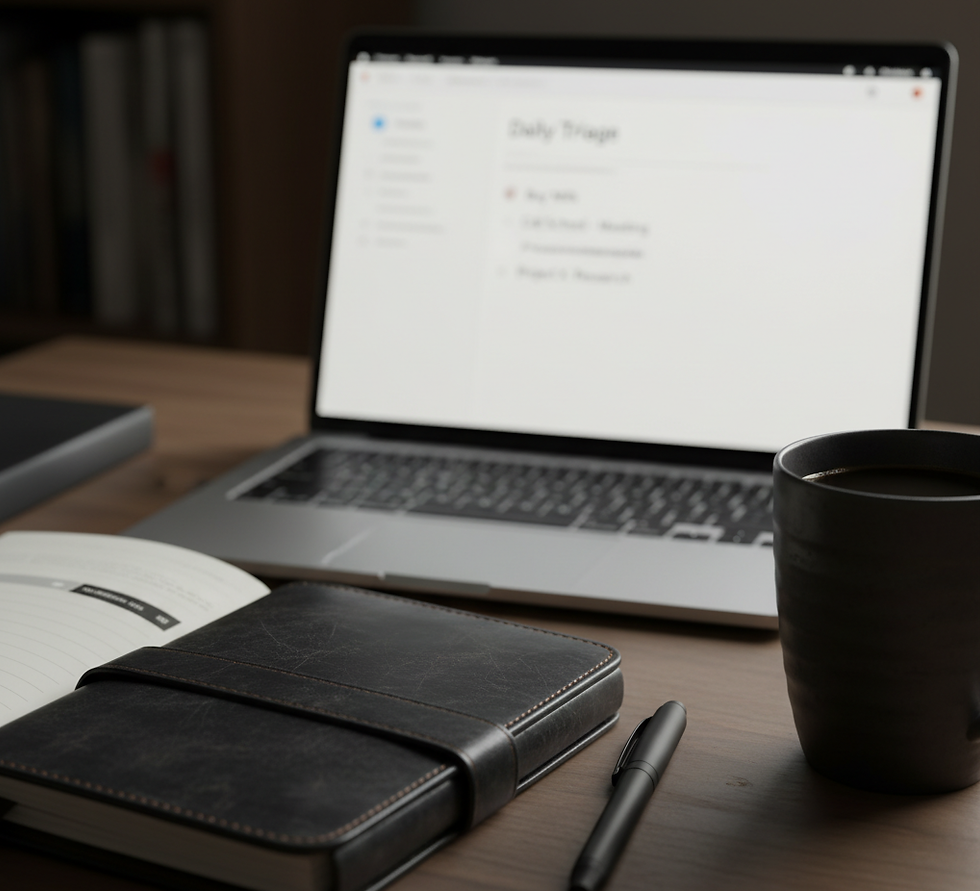
Choose Your Tools: This could be a small, dedicated notebook you carry everywhere, a simple notes app on your phone (like Google Keep or a dedicated task manager), or even a voice recorder. The best tool is the one you will actually use consistently.
Organize and Review (The Daily Triage): Once a day (perhaps during your "60-Minute Solo" time), quickly review everything you’ve captured. Triage what you’ve written down:
Do it now (if under 2 minutes): Use the "2-Minute Rule" we discussed in Issue #6!
Schedule it: Add it to your calendar or task list.
Delegate it: If someone else can do it.
Delete it: If it’s no longer relevant.
By consistently using an "external brain," you free up valuable mental energy that was previously spent trying to remember things. This allows you to be more present, more focused, and less prone to the anxiety of forgotten tasks.
A Quick BJJ Lesson: Creating Frames
In Jiu-Jitsu, when you’re caught in a bad position—say, an opponent has pinned you flat to the mat—you create ‘frames.’These are simple, strong structures using your arms and legs to create space between you and your opponent allowing you to move into a better position. Without a frame, the opponent crushes you; the pressure is suffocating.
Your “External Brain” is your mental frame. It creates a crucial space between a scattered, urgent thought and a feeling of panic, allowing you to breathe and execute the next play with clear intent, instead of reacting to the chaos.
1 Mindset Shift: Embrace Your Strengths
It’s easy to feel frustrated with yourself or your kids when things get chaotic or tasks are left unfinished. We often internalize these challenges as personal failings.
Your brain isn't broken; it just works differently. Instead of trying to fit a square peg into a round hole, understand your (or your child's) unique operating system. Embrace the strengths that come with neurodivergence—creativity, hyper-focus on passions, out-of-the-box thinking. Then, build systems that support those strengths and mitigate the challenges. Stop trying to change your operating system and start building the right structure around it.
1 Recommended Resource: ADHD 2.0: New Science and Essential Strategies for Thriving with Distraction
For anyone navigating the world with an ADHD brain—whether it's your own or your children's—I cannot recommend ADHD 2.0: New Science and Essential Strategies for Thriving with Distraction by Dr. Edward M. Hallowell and Dr. John J. Ratey enough. This book is a lifeline. It provides a hopeful, empowering perspective on ADHD, backed by cutting-edge science, and offers incredibly practical strategies for turning what might feel like a weakness into a superpower. It changed my understanding of myself and my kids.
Want a free system to help you get your life under control as a solo dad? Download the Free Solo Dad Starter Kit — 7 systems to help you run your household with less stress and more confidence.
Cheers to the journey,
Todd


Comments